Honda Civic Sticky Steering: Affected Years and Fixes
Why does the Honda Civic steering stick? We examine affected model years, worm gear failures, Honda's 2023–2025 fixes, recalls and owner complaints.


Contents
- Which Honda Civic Models Are Affected?
- What Causes the Honda Civic Sticky Steering Problem?
- What Does Sticky Steering Feel Like While Driving?
- Have Honda Civic Sticky Steering Problems Caused Accidents?
- How Did Honda Attempt to Fix the Steering Problem?
- Why Did Honda Change Its Steering Repair Procedure?
- Honda Civic Steering Complaints in Türkiye
- Were Civic Owners Still Reporting Steering Problems in 2025 and 2026?
- International Honda Civic Steering Recalls
- Did Honda Introduce the Same Repair in Türkiye?
- Which Honda Civic Model Years Should Buyers Be Most Careful About?
- What Should You Check Before Buying a Used Honda Civic?
- Has Honda Completely Fixed the Civic Steering Problem?
- Technical Documents and Sources
The 11th-generation Honda Civic has faced numerous complaints about steering resistance, stiffness and a noticeable sticking sensation when making small steering corrections. The issue has affected certain vehicles across several markets, particularly those produced between 2021 and 2024.
Some owners reported that their steering felt unusually heavy at motorway speeds, while others experienced repeated problems even after having their steering racks replaced.
But what actually causes the Honda Civic's steering to stick? Which model years are affected? And has Honda finally developed a lasting solution?
At Drivisual TV, we examined Honda's official technical service bulletins, engineering investigations published by the US National Highway Traffic Safety Administration (NHTSA), international recall records and documented owner complaints from multiple countries.
One of the most important findings is that Honda introduced an initial manufacturing improvement in 2023, continued receiving reports afterwards, and implemented a more comprehensive steering gearbox revision in August 2024.
Which Honda Civic Models Are Affected?
The issue primarily concerns certain 11th-generation Honda Civic models, including vehicles from the FE/FL generation.
The 11th-generation Civic began reaching customers in 2021, although availability varied between countries.
For example, the model officially went on sale in Türkiye on 13 November 2021, with locally sold saloon versions imported from Thailand.
In the United States, Honda's 24V744000 safety recall covers certain 2022–2025 Civic Saloon and Hatchback models, alongside the Civic Type R, CR-V, HR-V and selected Acura vehicles.
According to Honda's official recall documentation, the affected production period for the four-door Civic in the US extends from 16 February 2021 to 3 September 2024.
However, there is an important distinction between a vehicle's model year, actual manufacturing date and market-specific recall eligibility.
A 2025 model-year Civic may have been manufactured during 2024, while production specifications and recall coverage may differ between countries.
The previous 10th-generation Civic is not included in this specific US sticky-steering recall.
Sources: Honda – NHTSA Safety Recall 24V744 · Anadolu Agency – 11th-Generation Civic Launch in Türkiye
What Causes the Honda Civic Sticky Steering Problem?
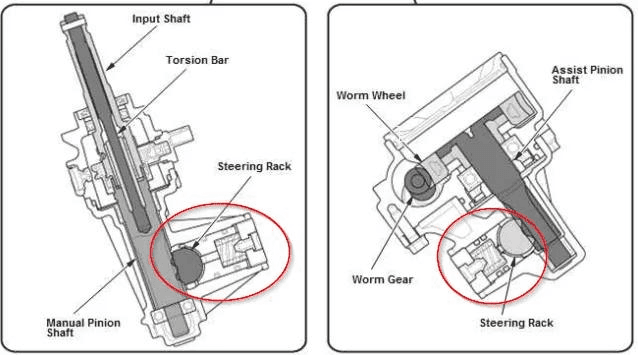
Cross-sectional illustration of an electric power steering system. The highlighted areas show mechanical components involved in transferring steering force.
Honda's technical documentation identifies excessive friction inside the electric power steering (EPS) gearbox as the underlying issue.
More specifically, the problem involves the interaction between the worm gear, worm wheel and spring-loaded preload mechanism.
In a normal electric power steering system, an electric motor provides assistance to the driver through a mechanical gear arrangement.
The worm gear transfers torque to the worm wheel, while a specialised lubricant reduces friction between the contact surfaces.
The preload spring maintains controlled engagement between the components.
However, Honda's engineering investigation identified three contributing factors that can combine to increase steering resistance.
1. Worm Wheel Deformation Over Time
According to the NHTSA engineering investigation, the manufacturing process used for certain worm wheels could leave residual stress within the material.
As these internal stresses gradually relax after production, the geometry of the gear teeth can change slightly.
Temperature, humidity and normal vehicle operation may influence this process.
The resulting changes can increase interference between the worm wheel and worm gear, requiring additional force to move the steering mechanism.
This helps explain why some owners reported that the problem appeared only after several months of driving rather than immediately after delivery.
2. Lubricating Grease Moving Away from the Contact Area
Honda initially investigated inconsistencies in the amount and distribution of grease applied during manufacturing.
However, the NHTSA's subsequent testing identified an additional mechanism.
As the worm gear and worm wheel operate, lubricant can gradually be displaced away from the primary contact surfaces.
This reduces the effective lubrication film between the gear teeth.
The problem is therefore not necessarily limited to insufficient grease during assembly. The movement of grease away from the working contact area can also increase friction over time.
The NHTSA's Vehicle Research and Test Center (VRTC) independently reproduced the increased steering effort reported by owners.
3. Excessive Spring Preload
A further contributor was the preload applied by the spring inside the steering gearbox.
The spring is designed to maintain engagement between the worm gear and worm wheel.
However, Honda's investigation found that excessive preload could create more friction than intended.
When this additional pressure is combined with worm wheel deformation and reduced lubrication, the steering mechanism may require noticeably greater effort to move.
The result is the characteristic sticking, notchy or unusually heavy steering sensation described by affected drivers.
These contributing factors are mechanical in nature. The issue cannot simply be explained as an ordinary infotainment or electronic software malfunction.
Source: NHTSA – EA23003 Engineering Investigation, 28 January 2025
What Does Sticky Steering Feel Like While Driving?
One of the most characteristic symptoms appears during small steering corrections at higher speeds.
When travelling along a relatively straight road, drivers continuously make small adjustments to maintain their position within the lane.
In an affected Civic, the steering wheel may initially resist these movements.
As the driver applies more force, the resistance can suddenly be overcome, making the steering movement feel less predictable than normal.
Owners have described the sensation in several ways:
- The steering wheel feels stuck around its central position.
- Small steering corrections require excessive effort.
- The steering feels notchy rather than smooth.
- Resistance suddenly disappears after additional force is applied.
- The steering does not return to centre as naturally as expected.
An important detail is that the problem may occur without triggering an EPS warning light or diagnostic fault message.
It can also be intermittent.
Some owners reported that the steering behaved normally during short dealership test drives, even though they experienced the problem repeatedly during longer motorway journeys.
This makes the condition more difficult to diagnose than a completely failed steering assistance system.
Have Honda Civic Sticky Steering Problems Caused Accidents?
The NHTSA's investigation demonstrates why this issue was treated as a potential safety defect rather than simply a comfort complaint.
The initial investigation began in 2023, following reports of increased steering effort.
As the investigation progressed, additional complaints and crash allegations were included.
The engineering investigation closed on 28 January 2025, following Honda's safety recall.
| NHTSA Investigation Findings | Reported Figure |
|---|---|
| Total reported incidents | 4,569 |
| Crash allegations submitted to NHTSA | 23 |
| Total crash allegations after combining relevant records and removing duplicates | 37 |
| Reported injuries | 8 |
| Reported fatalities | 0 |
These figures relate to the investigation's vehicle population, which initially included certain Civic, CR-V and Acura Integra models.
The 37 crash allegations do not mean that investigators conclusively established the steering defect as the cause of every collision.
Nevertheless, the reports formed part of the evidence considered during the federal safety investigation.
A Honda Civic Crash Allegation Reached the Courts
In April 2023, a proposed class-action lawsuit was filed in the United States concerning the alleged sticky-steering defect.
According to a statement published by the law firm Hagens Berman, one Civic owner claimed that the vehicle's steering failed to respond correctly in March 2023.
The driver alleged that the vehicle left the road, entered a ditch and was subsequently declared a total loss.
The complaint also described an injury associated with the incident.
However, this account represents allegations made in legal proceedings. It should not be interpreted as independent confirmation that the steering mechanism was conclusively established as the cause of the crash.
We also could not identify verified dashcam footage or authenticated accident-scene photographs directly documenting that particular incident.
Sources: NHTSA – EA23003 Investigation Closing Report · Hagens Berman – Honda Civic Sticky Steering Lawsuit, April 2023
How Did Honda Attempt to Fix the Steering Problem?
One of the most revealing aspects of this investigation is the development of Honda's manufacturing and repair procedures.
The company did not rely on a single technical change.
Instead, the official chronology shows several stages of investigation, component improvement and revised workshop procedures.
2023: Initial Manufacturing Changes and Steering Rack Replacement
According to Honda's recall chronology, the manufacturer received its first confirmed field report on 9 September 2021.
A broader quality investigation followed in November 2022, while the NHTSA opened its preliminary evaluation in March 2023.
On 19 July 2023, Honda identified deformation affecting the worm wheel teeth as a contributing factor.
The manufacturer subsequently revised the worm wheel moulding process.
Around the same period, Honda issued Service Bulletin 23-037, covering certain 2022–2023 Civic vehicles experiencing increased steering effort at medium and higher speeds.
The prescribed repair involved replacing the EPS steering gearbox assembly, while transferring certain electrical components from the original unit.
However, this first stage did not fully resolve the issue across the affected population.
Early 2024: Complaints Continued After the Initial Revision
Honda's official chronology states that further quality reports were received on 26 January 2024, following the earlier worm wheel manufacturing changes.
The investigation continued throughout the following months.
By August 2024, examination of returned components indicated that friction could remain excessive in certain steering gearboxes.
These findings encouraged Honda to examine the interaction between worm wheel geometry, lubrication and spring preload more comprehensively.
The original manufacturing improvement had addressed one potential cause, but additional contributing factors still needed attention.
30 August 2024: A More Comprehensive Manufacturing Revision
According to Honda's official recall report, revised steering gearboxes entered production from 30 August 2024.
The improvements addressed several areas:
- Manufacturing controls affecting worm wheel tooth geometry.
- Reduced preload spring force.
- Improved grease application to the worm gear and worm wheel contact surfaces.
The objective was to reduce unwanted internal friction and improve the consistency of steering effort.
This date represents an important milestone in Honda's documented US production history.
However, it should not automatically be used as the exact manufacturing changeover date for every Civic produced or sold internationally.
Vehicles assembled at different factories may have market-specific component specifications, production schedules and recall campaigns.
October 2024: Nearly 1.7 Million Vehicles Recalled
On 26 September 2024, Honda determined that a safety-related defect existed.
The company submitted its recall notification to the NHTSA on 3 October 2024.
The campaign, registered as 24V744000, covered 1,693,199 Honda and Acura vehicles in the United States.
This total includes several vehicle lines, not just the Honda Civic.
Honda's recall documentation also identified 10,328 warranty claims associated with the condition between September 2021 and September 2024.
That figure should not be interpreted as 10,328 confirmed crashes or necessarily 10,328 separate vehicles with an identical mechanical failure.
Source: NHTSA – Honda Safety Recall Report 24V744
Why Did Honda Change Its Steering Repair Procedure?
Honda's Service Bulletin 24-119 provides valuable information about how the repair strategy evolved.
Earlier service procedures had focused heavily on replacing the complete steering gearbox.
The subsequent recall repair instead addressed specific internal components responsible for excessive friction.
The updated procedure involves replacing the following parts inside the steering gearbox:
- The preload spring.
- The spring seat.
- The end cap.
Technicians also apply additional specialised grease to the gear contact area using a prescribed procedure.
Honda's revised instructions show that the company stopped accepting the earlier 06530-T20-305 repair kit and procedure from 1 November 2024.
The updated repair kit carries part number 06531-T20-305.
The eighth revision of Service Bulletin 24-119, dated 27 March 2025, further clarifies the official workshop procedure, including installation and torque-related instructions.
Why Does the Repair Kit Number Matter?
If a used Civic has already undergone steering repairs, knowing that the steering gearbox was simply "fixed" or "replaced" may not provide the complete picture.
The date of the repair, installed parts and applicable service campaign can be relevant.
A gearbox replaced in 2023, for example, should not automatically be assumed to contain every improvement introduced during the more comprehensive 2024 manufacturing revision.
However, this does not mean that all earlier replacement units were defective.
A proper assessment requires the installed component reference, production date and diagnostic history.
Another distinction is equally important: eight revisions of Honda's service bulletin do not represent eight separate failed repair attempts.
Some revisions concern workshop instructions, installation procedures and supporting technical information.
Source: Honda Service Bulletin 24-119 – Revision 8, 27 March 2025
Honda Civic Steering Complaints in Türkiye
The steering issue has also generated numerous owner complaints in Türkiye, where the 11th-generation Civic has been available since late 2021.
We examined publicly available reports on Şikayetvar, a Turkish consumer complaint platform.
The complaints describe several different symptoms, including steering stiffness, sticking around the centre position, noises from the steering rack and dissatisfaction following dealership repairs.
However, not every report necessarily involves the same mechanical defect.
For example, a knocking noise from the steering rack or a wheel alignment problem following repair work should not automatically be attributed to the worm gear friction mechanism described in Honda's US recall.
With that distinction in mind, several Turkish ownership experiences are particularly informative.
2022 Civic: Sticky Steering Resolved After Gearbox Replacement
On 1 April 2024, an owner of a 2022 Civic reported that the steering had become unusually stiff and would occasionally stick while driving.
The owner stated that the problem had affected confidence during longer journeys and that a replacement steering gearbox had been requested months earlier.
In an update dated 15 April, the owner confirmed that Mutluhan Honda had replaced the steering gearbox under warranty.
The complaint was subsequently marked as resolved.
This is an example of a successful repair reported by an affected owner.
Source: Şikayetvar – Civic Steering Stiffness and Successful Repair
2023 Civic: Initial Repair Failed, Complete Gearbox Replacement Helped
A detailed complaint published in Samsun on 26 April 2024 provides an especially useful account of the repair process.
The owner of a 2023 Civic described steering stiffness, sticking and unusual noises.
According to the complaint, the authorised dealership initially carried out a procedure associated with Honda Türkiye's technical guidance.
However, the owner reported that the problem continued afterwards.
In an update on 5 May, the owner stated that the dealership had identified the fault again.
On 16 May, the owner reported being informed that the problem would be addressed through component replacement.
What was the final outcome?
In a further update published on 3 June, the owner stated that the steering gearbox had been replaced under warranty on 30 May.
The owner reported a significant improvement and considered the complaint resolved.
This case illustrates that an initial workshop intervention may not always eliminate the symptoms, while a more extensive component replacement can potentially resolve the problem.
Source: Şikayetvar – 2023 Civic Steering Fault and Repair Timeline
2023 Civic: Problems Reported After Steering Gearbox Replacement
Another owner reported in October 2024 that their 2023 Civic continued to experience steering-related symptoms despite having the steering gearbox replaced.
This type of complaint raises an important question about the components used during earlier repairs.
However, the replacement gearbox's exact part number and production date are not available in the public report.
It is therefore impossible to establish whether it incorporated the later manufacturing improvements.
The complaint also does not independently prove that the same internal worm gear defect had returned.
2022 Civic: Two Steering Gearbox Replacements and Continuing Noise
A complaint published in Elazığ on 2 December 2025 describes a 2022 Civic owner who had visited authorised workshops three times over approximately 18 months.
According to the owner, the steering gearbox had been replaced twice.
Despite these repairs, steering-related complaints and a knocking noise reportedly continued.
This experience deserves attention, but the distinction between different symptoms is important.
A knocking noise may originate from mechanical play, mounting components or other steering and suspension parts rather than the exact internal friction mechanism responsible for sticky steering.
Without a detailed workshop diagnosis, it would be misleading to conclude that Honda's revised worm gear design had failed again.
Source: Şikayetvar – Repeated Steering Gearbox Replacement Complaint
Recall Notifications and Replacement Parts Delays
Other Turkish complaints focus on the repair process rather than the original mechanical fault.
In September 2024, a Civic owner reported receiving a message from Honda Türkiye informing them that the steering gearbox required replacement.
In June 2025, another owner of a 2022 Civic stated that the vehicle had been recalled but that replacement parts had not arrived after approximately two months.
A separate complaint published on 21 August 2025 described an owner travelling from Çanakkale to a dealership in the Tekirdağ region for an arranged steering gearbox replacement.
Despite the confirmed appointment, the owner claimed that the required part was unavailable on arrival.
These experiences highlight another dimension of vehicle reliability: even when a manufacturer offers a repair, replacement part availability and service organisation can significantly affect ownership.
Sources: Şikayetvar – Civic Steering Gearbox Complaints · Owner Report of Missing Replacement Parts
Were Civic Owners Still Reporting Steering Problems in 2025 and 2026?
Yes. However, the publication date of a complaint must not be confused with the production date of the affected vehicle.
For example, an owner of a 2023 Civic reported continuing steering gearbox noise in June 2026, despite several workshop visits.
Another owner described steering-related concerns and uneven tyre wear following earlier steering repairs.
These reports may involve unresolved faults in older vehicles, repair-related alignment problems or separate mechanical concerns.
A complaint published in 2026 about a 2022 Civic does not prove that newly manufactured 2026 Civics still use the original defective components.
Similarly, steering noises and abnormal tyre wear cannot automatically be classified as recurrence of the sticky-steering defect.
The available public reports do not provide enough information to calculate a reliable failure rate for repaired vehicles.
Source: Şikayetvar – Honda Civic Steering Gearbox Owner Reports
International Honda Civic Steering Recalls
The steering gearbox issue was not confined to vehicles sold in the United States.
Honda and national safety authorities announced related product updates in several other markets.
Although the underlying mechanical descriptions are similar, recall populations and repair procedures are market-specific.
Canada: Approximately 239,000 Vehicles
On 9 October 2024, Honda Canada announced a recall affecting approximately 239,000 Honda and Acura vehicles.
The manufacturer explained that the worm wheel could expand under certain temperature and humidity conditions.
Combined with reduced lubrication and excessive preload, this could increase steering friction.
The remedy involved an improved spring and additional grease.
Source: Honda Canada – Steering Gearbox Recall, October 2024
Malaysia: Approximately 36,000 Vehicles
Honda Malaysia announced a product update on 6 November 2024, covering approximately 36,000 vehicles.
The affected population included certain:
- 2022–2024 Honda Civic models.
- 2023–2024 Honda Civic Type R models.
- 2024 Honda CR-V models.
The manufacturer identified worm wheel expansion and a reduction in the lubrication film as contributing factors.
This is particularly relevant when examining Civic models manufactured or sold outside North America.
Source: Honda Malaysia – Official Product Update
Australia: 16,001 Vehicles
Australia's official vehicle recall database recorded a campaign under reference REC-006150, published on 7 November 2024.
The campaign involved 16,001 vehicles across selected Civic, Civic Type R, CR-V and ZR-V variants.
The official documentation described a potential reduction in lubrication between steering gear components, resulting in increased friction and steering effort.
Source: Australian Government – Recall REC-006150
United Kingdom: 2025 Recall Campaign
The UK also recorded a steering-related product update under recall reference R/2025/024.
The campaign included selected Civic e, Civic Type R and other Honda models.
The reported repair approach differed depending on the application.
For certain conventional models, the procedure involved replacing the preload spring and improving lubrication.
For some Civic Type R vehicles, steering gearbox replacement was specified.
This illustrates why repair recommendations should not be generalised across every Civic variant.
Source: UK Recall Reference R/2025/024
Did Honda Introduce the Same Repair in Türkiye?
Publicly available Turkish owner reports indicate that both complete steering gearbox replacement and preload spring-related product updates have been performed.
A post published on HondaTR Forum in April 2025 describes an update involving the replacement of the preload spring and application of additional grease on certain Civic FE1 vehicles.
The procedure is mechanically similar to the remedy described in Honda's US Service Bulletin 24-119.
However, we have not obtained a publicly accessible Honda Türkiye technical bulletin listing the complete affected VIN ranges, local campaign reference numbers and manufacturing changeover dates.
Consequently, US or Canadian recall numbers should not automatically be treated as applicable to Turkish-market vehicles.
Owners in Türkiye can check for outstanding manufacturer campaigns through Honda's official vehicle identification number service:
Honda Türkiye – Official Recall Check
Which Honda Civic Model Years Should Buyers Be Most Careful About?
Honda's official US production chronology and owner reports provide useful context, although they do not establish a precise worldwide failure rate.
| Model Year | Reliability Considerations |
|---|---|
| 2021 | Early 11th-generation introduction in some markets; distinguish FE models from the previous generation |
| 2022 | Early production population with numerous steering complaints |
| 2023 | Complaints continued; Honda introduced its first manufacturing improvement |
| 2024 | Problems were still reported; more comprehensive production changes arrived in August |
| 2025 | Some US 2025 model-year vehicles were included in the recall; VIN verification remains important |
| 2026 | Insufficient evidence to establish that the original defect persists in newly manufactured vehicles |
Insufficient evidence to establish that the original defect persists in newly manufactured vehicles
The key point is that model year alone is not a reliable indicator of which steering gearbox revision a particular vehicle contains.
A 2025 model-year car may have been manufactured before the August 2024 improvements.
Equally, a 2024 model may have undergone the relevant repair successfully.
For used-car buyers, the vehicle's production date, VIN and documented service history are more useful than assuming that an entire model year is either defective or problem-free.
What Should You Check Before Buying a Used Honda Civic?
Anyone considering a used 11th-generation Civic should pay particular attention to the steering system's repair and recall history.
Before purchasing, we recommend checking the following:
- Recall status: Confirm whether the vehicle has any outstanding safety recalls or manufacturer product updates.
- Steering gearbox replacement: Ask whether the EPS steering gearbox has ever been replaced.
- Spring and lubrication update: Check whether the relevant preload spring and grease remedy was completed.
- Repair date and parts: Request workshop invoices showing which components and service procedures were used.
- Recurring symptoms: Ask whether sticking, unusual steering effort or noise returned after repair.
- Wheel alignment: If the steering gearbox was removed or replaced, confirm that the necessary alignment and final checks were completed.
During a test drive, pay attention to how smoothly the steering responds to small corrections around its central position.
The steering should move consistently and predictably without sudden resistance or a notchy sensation.
However, because some owners report symptoms only after extended driving, a short test drive without problems cannot guarantee that the vehicle is unaffected.
If the steering feels abnormally stiff, sticks unexpectedly or behaves unpredictably, the vehicle should be inspected by an authorised repairer before further normal use.
Owners should not attempt to modify or lubricate the internal steering gearbox themselves. Honda's official procedure requires specialist equipment and trained technicians.
Has Honda Completely Fixed the Civic Steering Problem?
The available technical evidence confirms that Honda introduced meaningful mechanical improvements during 2024.
These included changes to worm wheel production, reduced spring preload and improved lubrication.
The subsequent updated repair procedure also directly addressed the mechanical factors identified during the investigation.
According to an NHTSA recall progress report dated 14 April 2026, repairs had been completed on 1,460,342 vehicles out of the original 1,693,199-vehicle US recall population.
This indicates substantial progress in carrying out the campaign.
However, completion of a recall repair does not guarantee that a vehicle will never experience another steering-related fault.
Likewise, reports of continued steering noises after earlier repairs do not prove that every revised steering gearbox is defective.
Our assessment at Drivisual TV is that the Honda Civic sticky-steering problem is a genuine mechanical safety defect supported by manufacturer documentation and an extensive regulatory investigation.
Honda introduced an initial manufacturing improvement in 2023, followed by a more comprehensive revision in August 2024 that addressed gear geometry, spring preload and lubrication.
Related recall and repair campaigns were also launched in several international markets.
However, this does not mean that every 11th-generation Civic will develop the problem.
Nor does it mean that a particular model year can be declared completely free from steering faults without examining the individual vehicle.
For used Civic buyers, the most valuable information is therefore not simply the model year or mileage, but the steering gearbox revision, recall status and documented repair history.
Editorial note: This investigation is based on manufacturer documentation, NHTSA engineering reports, international recall records and publicly available owner complaints reviewed up to 25 October 2026. Individual owner accounts have not all been independently verified. Recall eligibility and repair requirements must be confirmed using the vehicle's VIN and the relevant national Honda service network.
Technical Documents and Sources
Official manufacturer and regulatory documents
- NHTSA – Honda 24V744 Safety Recall and Manufacturing Changes
- NHTSA – EA23003 Sticky Steering Engineering Investigation
- Honda – Service Bulletin 24-119, Revision 8, 27 March 2025
- NHTSA – Honda 24V744 Recall Completion Report
- Honda Canada – Steering Gearbox Recall
- Honda Malaysia – Official November 2024 Product Update
- Australian Government – Recall REC-006150
Owner experiences and further research
Comments (0)
🌍 Drivisual.tv is visited from over 60 countries. No matter what language you write in, your thoughts can help a fellow car enthusiast on the other side of the world thanks to our instant AI translation. Feel free to share your thoughts in your native language!
No comments yet. Be the first to share your thoughts!
Leave a Reply