
Subaru Getaway: Electric Family SUV and the Brand's EV Transformation

Elektrification is no longer just a new powertrain preference in the automotive world; it has become a strategic transformation space that is redefining brand identities. Especially in the family-oriented SUV segment, as competition accelerates, manufacturers are not only trying to offer longer range or higher performance; they are also required to respond to users’ lifestyles, digital expectations, and mobility habits.
Subaru’s fully electric three-row SUV model, introduced at the 2026 New York Auto Show, Subaru Getaway, is positioned right at the center of this transformation.
Defined by the brand as the “fourth member of its electric family,” the Getaway is not just a new model. It is also a strategic signal indicating that Subaru’s electric vehicle vision is beginning to mature. With its three-row seating layout, seven-passenger living space, standard dual-motor AWD architecture, 420 hp output, and a target range of over 300 miles, the model stands out as the largest and most powerful electric vehicle in Subaru’s history.
More importantly, the Getaway aims to bring together the brand’s long-standing adventure-oriented DNA with modern EV technology under one roof.
Today, in the electric SUV market, not only technological capability but also brand character preservation is critical. Because for many loyal Subaru users, a car is not just a means of transportation; it is part of a lifestyle that includes camping, skiing, long-distance travel, and outdoor culture.
The Getaway is asking exactly this question: Can an electric Subaru still be a “real Subaru”?
Subaru Getaway Launch and Its Position in the Brand’s Electric Family
For Subaru, the introduction of the Getaway carries a broader meaning than a classic product launch.
The brand’s electric mobility journey became visible largely with the Solterra. However, although the Solterra represented an important technical first step, it did not fully reflect the spacious family SUV character expected by Subaru’s loyal user base.
The Getaway aims to fill this gap.
According to Subaru’s statements, the model is positioned as the fourth pillar of the brand’s electric lineup. This definition points not only to the number of models but also to the gradual evolution of its next-generation EV strategy.
After long years of a cautious approach to electrification, Subaru has begun adopting a more aggressive stance in the last two years.
There are several key reasons behind this shift.
Development of the EV Lineup After the Solterra
In its first phase, the Solterra represented Subaru’s controlled entry into the EV world. Developed in partnership with Toyota, the platform provided the brand with battery architecture and software experience.
However, the EV market is changing rapidly.
Today, users no longer only want compact crossovers. They demand large family SUVs, premium living space, high range, and advanced digital systems.
The Getaway responds directly to these evolving expectations.
Subaru is now clearly moving from being merely a “brand that has EVs” to building a multi-layered electric product portfolio.
What Does the Name “Getaway” Mean in Brand Language?
Subaru’s naming strategy has long been based on lifestyle-oriented associations.
Names like Outback, Forester, or Crosstrek directly evoke adventure and exploration.
The name “Getaway” continues this tradition.
Conveying meanings such as escape, short trip, or getting away, the name aligns with the brand’s outdoor and travel culture messaging.
This is not a coincidence.
While many brands in the EV era are shifting toward technical naming conventions, Subaru continues to prioritize emotional brand connections through traditional naming language.
This may be particularly important for its loyal user base.
The Rise of the Three-Row Electric SUV Segment
One of the fastest-growing areas in the EV market is the three-row SUV segment.
There are several reasons for this.
First, family-oriented consumers are not abandoning SUV preferences. Second, new battery architectures are more efficiently utilized in larger vehicle bodies.
As a result, a new competitive space has emerged.
Today, the three-row EV SUV segment is no longer a premium niche.
Mainstream manufacturers are actively investing in it.
The Subaru Getaway arrives at exactly this moment.
Its rivals include not only large SUVs but also technologically advanced models.
In particular, vehicles like the Kia EV9 and Hyundai Ioniq 9 have already raised the segment’s standards.
Therefore, the success of the Getaway will depend not only on the Subaru badge but on the entire user experience it delivers.
Subaru’s New Generation EV Design Language and the Character of the Getaway
The design language of electric vehicles has changed significantly in recent years. Traditional SUV design cues such as large grilles and mechanical emphasis have been replaced by more aerodynamic, digital, and minimal surfaces. However, with the Getaway, Subaru chooses a more balanced approach rather than a fully futuristic design direction, preserving its brand identity.
This choice is important.
Because for Subaru users, design is not only about aesthetics but also about function and trust.
This philosophy is clearly reflected in the Getaway’s design.
Front Design and EV Identity
At first glance, the front of the Getaway does not completely abandon the brand’s traditional SUV genetics.
The closed EV panel, aerodynamic surfaces, and slimmer LED lighting emphasize the electric identity while maintaining Subaru’s robust stance.
A key visual element is the lighting architecture.
The horizontal daytime running lights give the vehicle a wider appearance, while the central lighting theme creates a unified visual identity for Subaru’s new EV family.
In electric vehicles, the front design is not only a visual element.
Aerodynamics directly affects driving range.
Therefore, the Getaway’s front end appears to feature airflow-guiding surfaces and a cleaner design language.
Despite its tall body, the relatively smooth silhouette is also part of this optimization.
Subaru manages a notable balance here:
The vehicle does not feel like a radical tech showcase, nor does it resemble a converted internal combustion SUV.
Rear Design and Lighting Signature
The rear section of the Getaway presents a more modern and premium approach.
The full-width lighting graphic aligns with current EV design trends.
This design is not purely aesthetic.
The wide light signature visually balances the large body and improves nighttime visibility.
The upright tailgate design also supports the family SUV philosophy.
Unlike coupe SUV trends, Subaru prioritizes usability here.
This decision is particularly meaningful for third-row and cargo space considerations.
Overall, the design philosophy emphasizes functional premium rather than dramatic styling.
This is consistent with Subaru’s brand identity.
Family-Oriented SUV Design Philosophy
In many electric SUVs, technology is prioritized while daily usability scenarios are often overlooked.
Subaru takes a different approach.
The Getaway feels designed not only for city driving but also for family trips, outdoor activities, and long-distance travel.
High roofline, large glass surfaces, and wide door openings support this intention.
For families with children, interior access, third-row entry, and visibility are critical.
The Getaway’s architecture is built around these needs.
Interior Architecture and Seven-Seat Layout
Buyers of three-row SUVs generally prioritize similar factors:
Space, access, practicality, and comfort.
The Getaway interior is designed to respond directly to these expectations.
Is the Seven-Seat Configuration Truly Practical?
Many seven-seat vehicles appear spacious in theory, but the third row is often only suitable for children.
The Getaway’s long wheelbase aims to reduce this limitation.
The second-row sliding mechanism improves access to the third row.
This can make a meaningful difference for larger families.
In long-distance use cases, such as families with three children traveling with ski or camping equipment, Subaru’s design philosophy becomes clearer.
The vehicle is not only about transporting people but supporting a lifestyle.
Cargo Space and Practical Usage
Cargo management is critical in three-row SUVs.
Providing sufficient storage with the third row in use is a challenge not all manufacturers solve well.
The upright rear design and flat floor architecture of the Getaway may provide an advantage here.
Foldable seating configurations also transform the vehicle into a multi-purpose space.
One day a school shuttle, the next day a camping vehicle.
This is exactly the usage scenario Subaru is targeting.
Ssource: Subaru
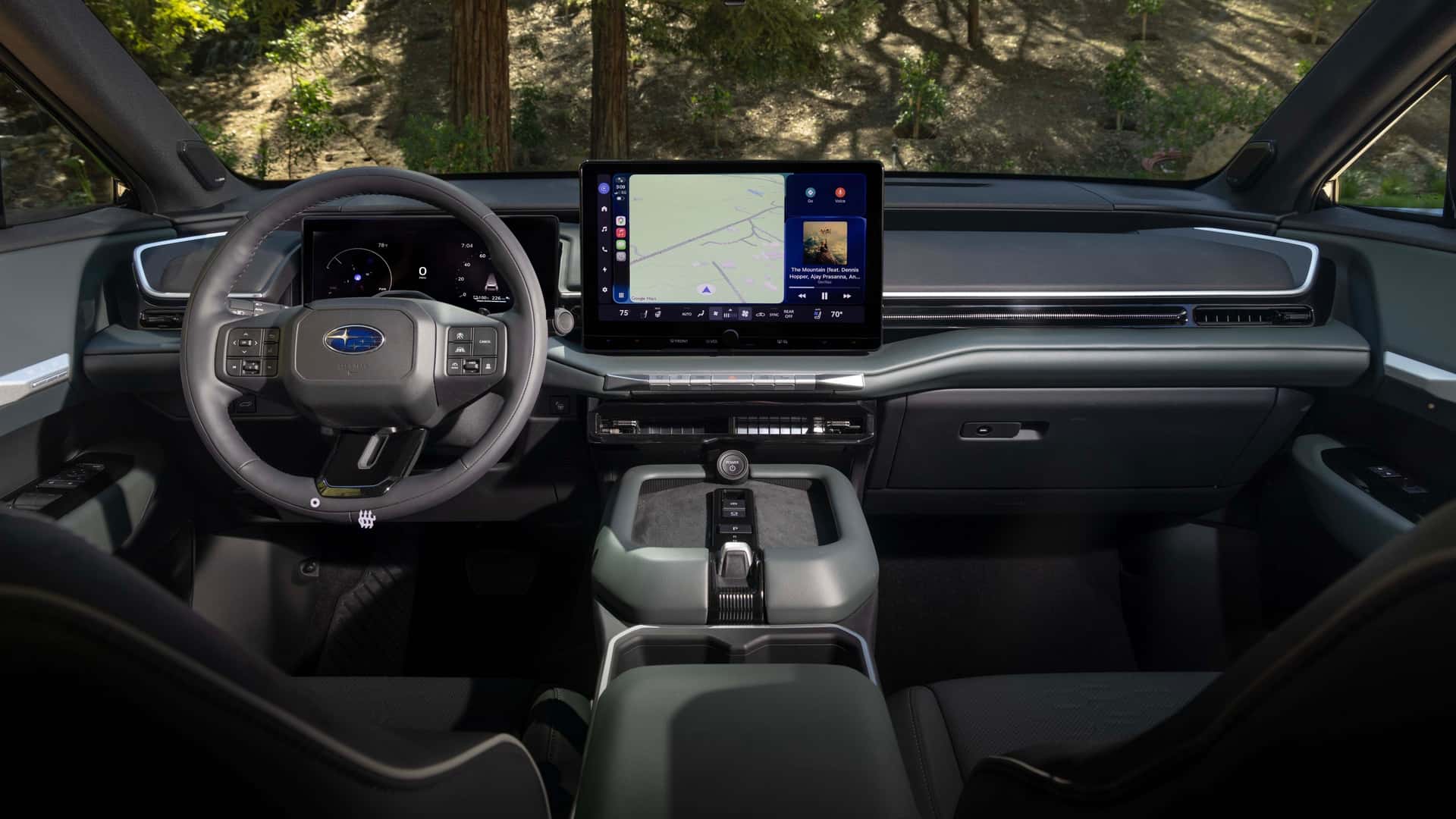
Digital Cockpit and Multimedia System
EV users now purchase not only driving performance but also digital experience.
The Getaway cockpit approach is minimalist yet technology-heavy.
A large central display, simplified control layout, and software-driven interface stand out.
However, the retention of physical controls is also important.
Because access to basic functions while driving still affects usability.
Subaru avoids the extreme digitization approach seen in some competitors.
This may be positively received by traditional Subaru users.
EyeSight Safety Technologies and User Experience
Safety plays a central role in Subaru’s brand perception.
EyeSight driver assistance systems have long been a core brand element.
The Getaway introduces a new-generation adaptation of these systems for EV architecture.
Lane keeping assist, adaptive cruise control, collision prevention systems, and advanced environmental sensing play key roles.
However, the real focus is not the feature list.
It is how seamlessly these systems operate without disturbing the driver.
Subaru is known for its non-intrusive assistance behavior.
The Getaway is expected to continue this approach.
Dual-Motor AWD Architecture and the Electric Interpretation of Subaru DNA
When Subaru is mentioned, one of the first technical features that comes to mind is all-wheel drive.
Therefore, AWD plays a crucial role in the brand’s electric future.
The Getaway represents not just an electric SUV but also an interpretation of Subaru’s character in the EV era.
Electrified Symmetrical AWD System
In traditional Subaru models, Symmetrical AWD is based on mechanical architecture.
In electric vehicles, the situation changes.
The Getaway’s dual-motor system electronically manages the front and rear axles.
The key advantage of this system is response speed.
Instead of mechanical differentials, torque distribution is controlled via software in milliseconds.
The result is faster traction management.
Subaru’s goal is not only safety on slippery surfaces.
It is preserving the brand’s driving character.
The sense of control associated with a Subaru in snow, mud, or gravel must continue in the EV era.
The Getaway is designed precisely for this purpose.
Expert Commentary
The Subaru Getaway, based on its specification sheet, comfortably fits into the “competitive three-row electric SUV” category. However, the critical point is that this vehicle is not just a product, but a psychological milestone in Subaru’s EV strategy.
The brand remained cautious in electrification for a long time and took its first step with the Solterra. The Getaway shows that this cautious approach is now being replaced by a clearer product vision. 420 hp output, a target range above 300 miles, and a 95.8 kWh battery pack indicate that Subaru now aims to be a competitive EV manufacturer rather than a reactive one.
The AWD system is the most critical engineering element of this vehicle. As Subaru’s Symmetrical AWD heritage transitions into electric form, mechanical simplicity is replaced by software-controlled torque distribution. If managed correctly, this transformation can maintain a strong emotional connection with the brand’s existing user base.
However, there are two key risks:
First is charging architecture and real-world efficiency. 150 kW DC fast charging is considered “adequate” by current standards, but segment leaders are pushing higher values. Therefore, long-distance performance will be defined not only by battery capacity but also by charging curve behavior.
Second is pricing. Subaru traditionally operates in the “accessible premium” segment. However, the three-row EV SUV market is under strong upward pricing pressure. If the Getaway becomes trapped in the same psychological pricing range as competitors like EV9, it could directly affect its success potential.
Still, Subaru’s biggest advantage is brand loyalty. Especially in North America, Subaru customers are connected to the brand through lifestyle rather than just transportation. The Getaway is one of the rare models capable of redefining this bond in the electric era.
Conclusion / General Evaluation
The Subaru Getaway is not just a new electric SUV technically; it is the most concrete step in the brand’s identity transformation.
Its three-row structure, focus on family usability, and retention of AWD character show that Subaru has not completely abandoned its traditional DNA. At the same time, elements such as 420 hp output, modern battery architecture, and NACS compatibility demonstrate a stronger integration into the EV ecosystem.
In segment terms, the Getaway directly competes with strong rivals such as the Kia EV9 and Hyundai Ioniq 9. In this context, Subaru’s differentiation will not come from raw performance figures but from “usage feel” — the sense of safety, practicality, and long-distance confidence it provides to both drivers and families.
On the design side, Subaru’s decision to avoid an overly futuristic language and instead adopt a functional and familiar design approach aligns with its strategy to retain its customer base. While this may be perceived as conservative in some markets, it offers a reassuring sense of continuity for loyal users.
As the global EV market matures rapidly, the three-row SUV segment is no longer niche but mainstream. Within this transformation, the Subaru Getaway’s position is clear: not a late entry, but a carefully timed and strategically controlled move.
From a European market perspective, the situation is more complex. While Subaru has a smaller footprint in Europe compared to North America, the region is highly competitive in electrification and heavily regulated in emissions and efficiency standards. If the Getaway is introduced in Europe, it will likely face strong pressure on pricing, efficiency certification, and CO₂ compliance, but it could still find a niche audience among lifestyle-oriented SUV buyers who prioritize AWD capability, practicality, and brand identity over pure efficiency metrics.
In conclusion, the Subaru Getaway is not a revolution, but a very clear strategic evolution. And this evolution may allow Subaru to avoid fading in the electric era and instead reposition itself while preserving its core identity.
If Subaru can support this model with strong software quality, real-world range performance, and balanced pricing, the Getaway could become one of the most important turning points in the brand’s EV era.
Comments (0)
🌍 Drivisual.tv is visited from over 60 countries. No matter what language you write in, your thoughts can help a fellow car enthusiast on the other side of the world thanks to our instant AI translation. Feel free to share your thoughts in your native language!
No comments yet. Be the first to share your thoughts!
Leave a Reply