
Car Tires Guide: Everything You Need to Know for Safety, Performance, and Longevity

If you ask what the most critical safety component of a car is, most people would say the brakes or the engine.
But the truth is much simpler—and more striking:
The only part of your vehicle that touches the road is the tires.
And this contact area is only about the size of a few palms. This small surface carries tons of weight, brings your car to a stop, and keeps you in control. That’s why choosing and maintaining the right tires is not just about performance—it’s about safety and survival.
In this article, we cover the most critical aspects of tire selection and maintenance in a professional and comprehensive way.
Why Are Car Tires So Important?
Tires don’t just make your car move—they directly affect:
- Braking distance
- Cornering stability
- Fuel consumption
- Driving comfort and safety
Low-quality, incorrect, or worn tires—especially those with reduced tread depth—can:
- Increase braking distance
- Reduce cornering stability
- Increase the risk of aquaplaning
- Raise fuel consumption
- Put overall driving safety at risk
What Makes an Ideal Car Tire?
1. Seasonal Suitability
The foundation of proper tire selection is choosing according to the season:
- Below 7°C → Winter tires
- Above 7°C → Summer tires
- Mild climates → All-season tires
Winter tires:
- Have a softer rubber compound
- Do not harden in cold temperatures
- Provide superior grip on snow and ice
Summer tires:
- Optimized for warm conditions
- Offer shorter braking distances
📌 Critical detail:
Winter tires must have the 3PMSF (Three-Peak Mountain Snowflake) symbol. This indicates that the tire has passed official winter performance tests.
2. Correct Tire Size and Compatibility
The right tire must always match the manufacturer’s specifications.
Using incorrect sizes can:
- Damage the suspension system
- Reduce handling performance
- Negatively affect systems like ABS and ESP
3. Tread Depth: The Foundation of Safety
Tread depth determines how well your tire grips the road.
Key values:
- Legal limit: 1.6 mm
- Recommended minimum:
- Summer: 3 mm
- Winter: 4 mm
As tread depth decreases:
- Braking distance increases
- Wet grip decreases
- The risk of losing control rises significantly
4. Tire Age and Rubber Condition
Tires degrade over time—even if they are not used heavily.
- Average lifespan: 40,000 – 50,000 km
- Shelf life: 5 years
- Maximum usage: 10 years
Over time:
- Rubber hardens
- Grip decreases
- Safety risks increase
Tires older than 5 years should be inspected regularly.
5. Tire Pressure: The Hidden Performance Factor
Incorrect tire pressure is one of the most common mistakes.
Low pressure:
- Increases fuel consumption
- Causes uneven wear
High pressure:
- Reduces grip
- Decreases comfort
📌 Tire pressure should always be checked when cold and according to manufacturer specifications.
6. Fuel Efficiency and Noise Levels
According to European tire labels:
- A–C rating → better fuel efficiency
- 67–71 dB → quieter ride
Professional Tips for Tire Selection
Comfort vs Performance
- High sidewall: Better comfort and shock absorption
- Low sidewall: Better handling and sporty performance
Are All-Season Tires Worth It?
- Advantage: One set for all year
- Disadvantage: Weaker performance in extreme winter conditions
Should All 4 Tires Be the Same?
Yes, absolutely.
Using different tires can cause:
- Uneven braking
- Imbalanced traction
- Malfunctions in electronic systems
How to Read Tire Codes
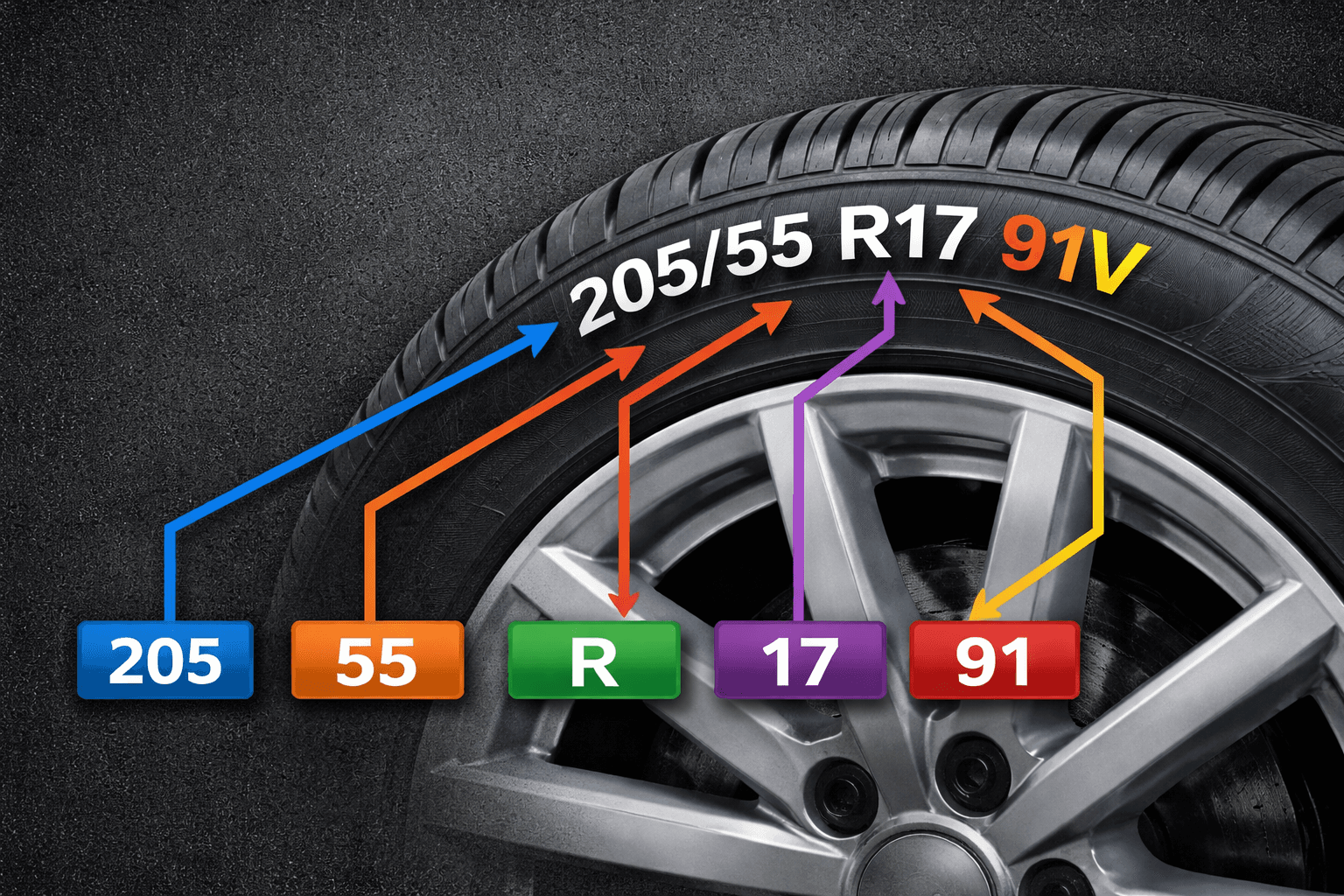
Example: 205/55 R17 91V
- 205 → width (mm)
- 55 → aspect ratio
- R → radial construction
- 17 → wheel diameter
- 91 → load index
- V → speed rating
These codes determine whether a tire is suitable for your vehicle.
Tire Size
DOT Code: How to Tell Tire Age
Example: 4723
- 47 → production week
- 23 → production year
Tires older than 5 years begin to lose performance.
Tire Markings: M+S vs 3PMSF
- M+S (Mud + Snow): Manufacturer claim
- 3PMSF: Tested and certified winter performance
For real winter safety, 3PMSF is essential.
Tire Types: Tubeless vs Tube Type
Tubeless:
- Safer
- Lighter
- More fuel-efficient
Tube Type:
- Requires an inner tube
- Older technology
How to Identify Tire Wear
- Reduced tread depth
- Increased vibration
- Cracks on the sidewalls
📌 When tread reaches 1.6 mm, the tire must be replaced.
Tire Lifespan: The Most Overlooked Risk
Tire lifespan is one of the most critical yet most neglected aspects of vehicle safety.
- Average lifespan: 50,000 – 80,000 km
- Usage duration: 5–6 years
- Maximum limit: 10 years
Worn-out tires:
- Harden over time
- Lose grip
- Reduce braking performance
Tires should always be checked after 5 years.
Scientific Ways to Extend Tire Life
1. Proper Pressure Maintenance
Check tire pressure at least once a month.
Incorrect pressure leads to:
- Uneven wear
- Higher fuel consumption
- Performance loss
2. Tire and Wheel Cleaning
- Avoid harsh chemicals
- Use water and mild soap
Otherwise:
- Sidewalls may crack
- Wheel coatings may get damaged
3. Wheel Balancing
If balance is off:
- Steering vibration occurs
- Tires wear unevenly
- Suspension components are affected
Balancing ensures even weight distribution across the wheel.
4. Tire Rotation
Rotating tires every 8,000 – 10,000 km:
- Ensures even wear
- Extends lifespan
5. Driving Style
- Hard braking → faster wear
- High speeds → heat and deformation
- Aggressive driving → shorter lifespan
The Right Tire Saves Lives
Tires are the most critical safety component of any vehicle.
Remember:
- All 4 tires should be the same type
- Check pressure monthly
- Inspect every 5,000 km
- Always check before long trips
- Protect tires from sun and chemicals
With the right tires, you get:
✔ Shorter braking distances
✔ Better road grip
✔ Lower fuel consumption
✔ Longer lifespan
✔ Maximum driving safety
Because the right tire doesn’t just improve performance—it saves lives.
Comments (0)
🌍 Drivisual.tv is visited from over 60 countries. No matter what language you write in, your thoughts can help a fellow car enthusiast on the other side of the world thanks to our instant AI translation. Feel free to share your thoughts in your native language!
No comments yet. Be the first to share your thoughts!
Leave a Reply