
The King of B-SUVs Maintains Its Shape: 2026 Volkswagen T-Roc Review

The Volkswagen T-Roc has long been a powerhouse in the compact SUV market, maintaining consistent sales dominance across Europe and global markets. However, the 2026 model year brings a bit of a puzzle: Is this a completely new generation, or just a very clever facelift?
While the industry often uses the "MK2" label for the 2026 T-Roc, this isn't a ground-up platform revolution. Instead, Volkswagen has retained the proven MQB architecture but significantly increased the vehicle's footprint and executed an extensive "deep facelift." By listening to long-standing user feedback, VW has polished the T-Roc’s weaker points, effectively pushing it into a more premium tech tier.
Exterior Design: Evolution or Revolution?
At first glance, the 2026 T-Roc looks much more substantial. This isn't just a visual trick; the technical data confirms it. The length has grown to 4,372 mm, a notable increase over its predecessor. Combined with a 2,629 mm wheelbase, this growth pushes the T-Roc out of the traditional B-SUV territory and right onto the doorstep of the C-SUV segment.
Where it once competed strictly with the likes of the Renault Captur, the new T-Roc has significantly narrowed the gap between itself and its bigger brother, the Tiguan.
- New Light Signature: A continuous LED strip stretching across the front grille provides a modern face similar to the Golf 8. The IQ.LIGHT - LED Matrix headlights don't just improve visibility—they grant the car a high-end nocturnal character.
- Rear Aesthetics: The light bar spanning the tailgate and the illuminated Volkswagen logo serve as the definitive hallmarks of VW’s new-gen design language.
- Trims: Available in Life, Style, and R-Line, the R-Line remains the standout for those seeking an aggressive stance with sportier bumpers and larger alloy wheels.
VW hasn't taken massive risks here. They’ve stuck to their "don't break it, improve it" philosophy, modernizing the aesthetic without alienating loyalists.
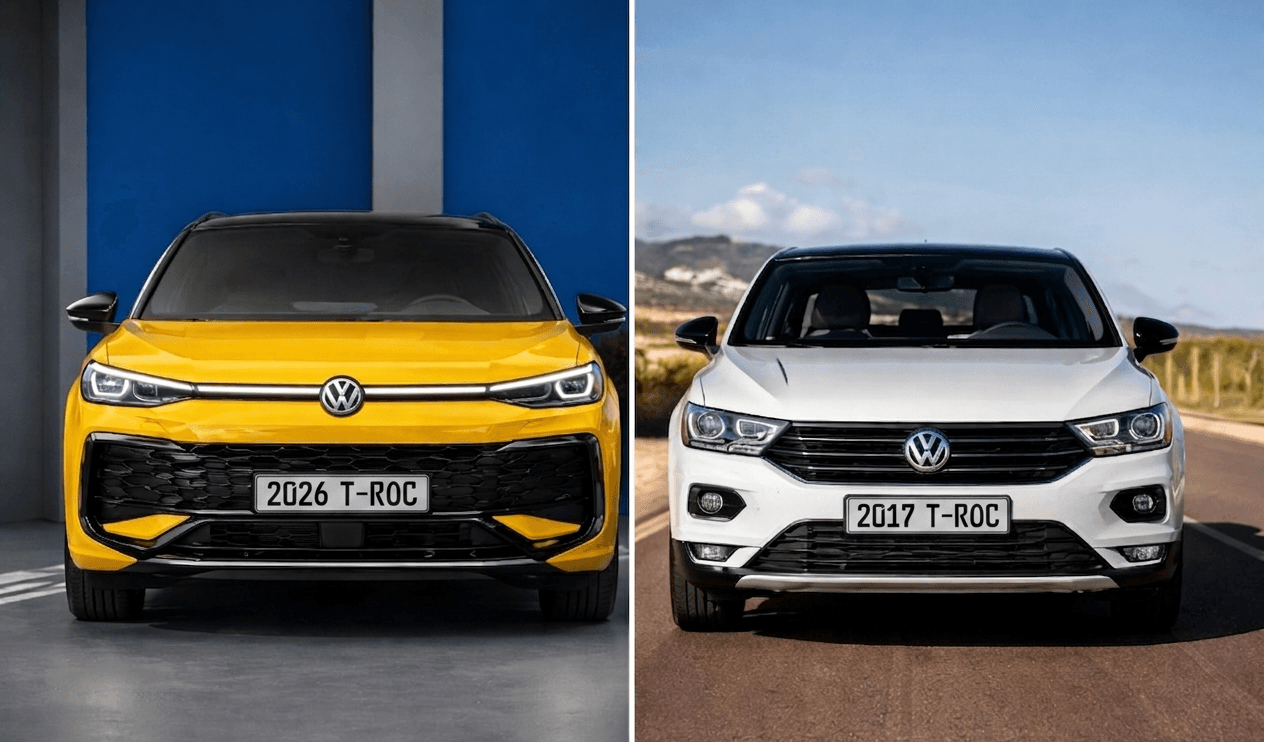
2026-2017 Volkswagen T-Roc Comparison
Interior: "The Hard Plastics Are Finally Gone"
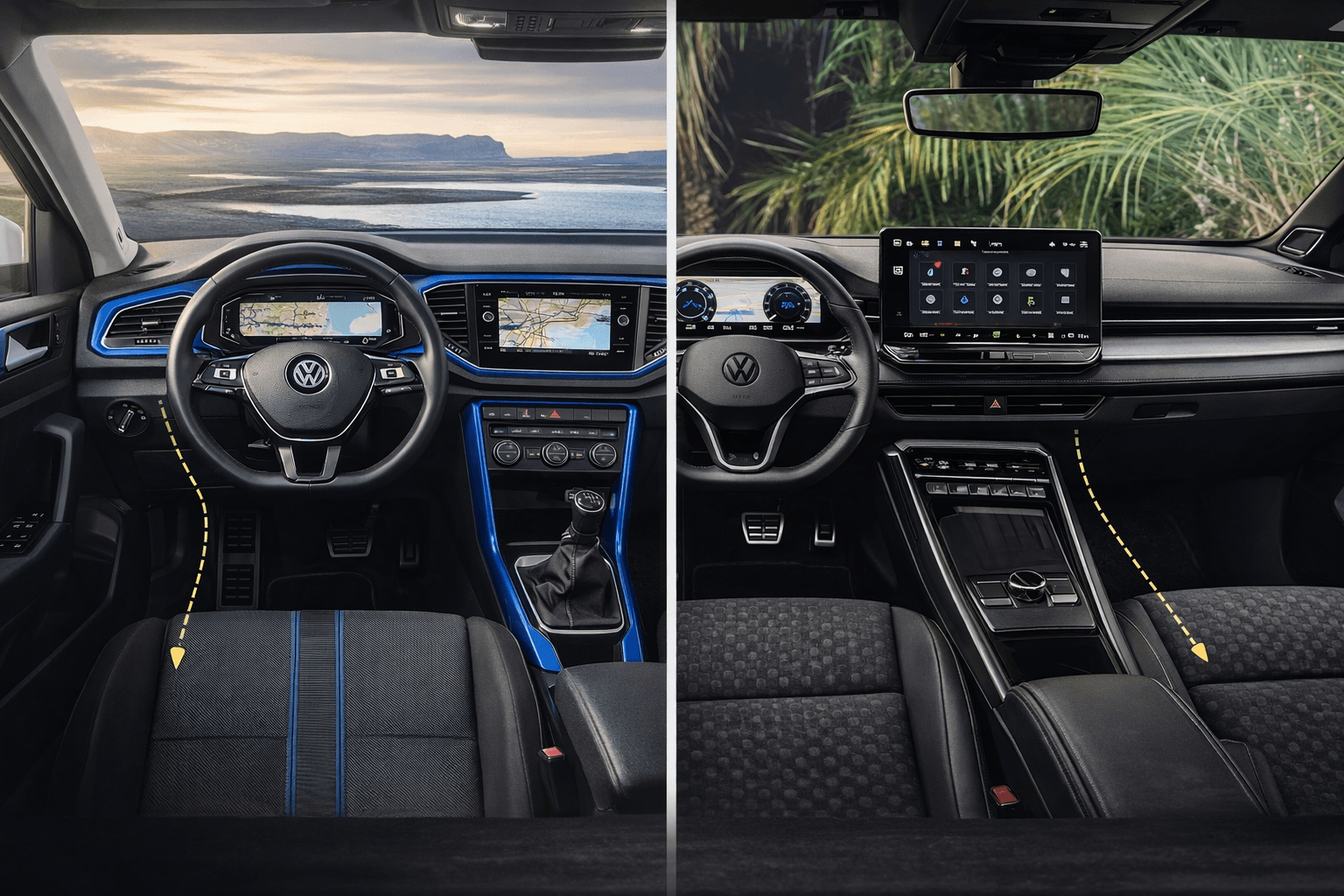
The most frequent complaint from previous T-Roc owners was the abundance of hard-touch plastics in the cabin. For 2026, Volkswagen has addressed this head-on.
The dashboard now features soft-touch materials and refined stitching, creating a significantly more premium atmosphere the moment you step inside. On the digital front, it’s a total overhaul:
- 12.9-inch Infotainment: A massive central screen running the latest MIB3 software offers a much smoother, lag-free user experience.
- Digital Cockpit: The standard 10.25-inch instrument cluster is highly customizable, putting vital driving data directly in your line of sight.
- Ergonomic Comfort: The Style trim introduces ergoActive seats with 14-way electrical adjustment and massage functions—a godsend for long-distance hauls.
The Catch: In the pursuit of minimalism, VW has removed most physical buttons. Moving climate controls and basic functions to the touchscreen can be distracting, a point of contention often raised by Golf 8 owners.
Engine and Performance: The eTSI Hybrid Era
The headline technical update for 2026 is the 1.5 eTSI mild-hybrid engine. Offered in 116 PS and 150 PS variants, this unit utilizes a 48V system to optimize both punchiness and fuel economy.
The "Coasting" or "Sailing Mode" is the star of the show. When you lift your foot off the accelerator, the engine can shut down entirely, allowing the car to glide and significantly reducing fuel consumption. In urban traffic, restarts are quieter and smoother, paired seamlessly with the ever-reliable DSG automatic transmission.
Performance-wise, the T-Roc remains "sufficiently brisk" rather than "fast." It has never been a car built purely for driving thrills, and that balanced, easy-going character remains unchanged.
Driving Dynamics and Safety
The 2026 T-Roc is smarter than ever. The introduction of Travel Assist brings a semi-autonomous driving experience to this class. Adaptive Cruise Control and Lane Assist take the heavy lifting out of highway cruising.
While the steering remains light and city-friendly, the insulation has been upgraded, making the cabin noticeably quieter. The suspension tuning favors comfort over sportiness, maintaining a stable and balanced ride.
Global Context: Features and Competition
It is worth noting that certain features remain region-specific. For instance, advanced autonomous driving packages and Plug-in Hybrid (PHEV) alternatives are often reserved for specific markets due to infrastructure and regional pricing strategies.
Market Rivals:
- Peugeot 2008: Leads in avant-garde design and interior tech.
- Toyota C-HR: A strong contender in pure hybrid efficiency.
The T-Roc’s advantage is its balanced package. It might not be the most economical or the most sporty, but it does everything "well enough" to be the most sensible all-rounder.
Final Verdict: Is It Worth It?
With the 2026 update, the T-Roc appeals to a broader audience. The expanded 475-liter boot makes it a viable primary car for small families.
Pros:
- Enhanced material quality and premium cabin feel.
- Improved fuel efficiency via eTSI mild-hybrid tech.
- Increased dimensions providing C-SUV levels of space.
- Balanced and predictable driving character.
Cons:
- Removal of physical buttons for climate control.
- Significant price increase compared to previous years.
If you are a current T-Roc owner, this model represents a major technological leap, even if it isn't a "true" next-gen platform. It successfully blends Volkswagen’s famous "solid build" feel with 2026-era tech. The T-Roc remains one of the most balanced choices in its class—it’s just a bit more mature (and expensive) than it used to be.
Comments (0)
🌍 Drivisual.tv is visited from over 60 countries. No matter what language you write in, your thoughts can help a fellow car enthusiast on the other side of the world thanks to our instant AI translation. Feel free to share your thoughts in your native language!
No comments yet. Be the first to share your thoughts!
Leave a Reply