
Tesla Battery Degradation: Normal Range Loss & Service Guide

Tesla Battery Degradation: What is Normal Range Loss and When to Visit the Service Center?
You bought a brand-new Tesla, put your first 10,000 to 15,000 miles on the odometer, and suddenly notice the estimated full-charge range on the screen has dropped by a solid 5% to 10%. At this point, most owners hit the panic button, thinking, "Am I killing the battery? Is it dying?"
Let's cut to the chase: There is no problem here. This isn't a chronic hardware failure; it is simply the physical and chemical reality of lithium-ion cells. Let's ignore the noise and misinformation floating around the forums. What is true battery degradation (capacity loss), what does the battery chemistry under your floor actually allow, and when do those numbers on the screen genuinely point to a hardware malfunction? We are diving straight into the mechanics and the data.
The First-Year Drop and the Plateau Phase (What Does the Math Say?)
Tesla Model 3: Kilometreye Bağlı Menzil Azalması
1.000 mil hareketli ortalama kesiti (Orijinal Veriler)
Battery wear isn't linear. There is no straight math like "I will lose 2% of my range every year." The lifecycle curve of lithium-ion batteries features a steep initial drop, followed by a long, flat plateau.
During the battery's "settling" phase in the first 20,000 miles, a 5% to 8% capacity loss is completely normal. The cells undergo their first intense stress tests and chemically stabilize. After this point, the degradation rate slows down massively, dropping to under 1% per year.
Sometimes, the range drop you see on the screen isn't even hardware-related; it's entirely about the software Tesla pushes to the car. When the vehicle's algorithm changes, the EPA estimate on your screen changes too. The widely discussed Tesla Model Y range reduction after OTA update wasn't a hardware degradation issue; it was purely the software altering its range calculation math.
LFP vs. NMC: Know Your Hardware
If you drive a Tesla, you need to know the battery chemistry under the chassis because it directly dictates how you should charge your car.
- NMC Batteries (Long Range & Performance): Nickel-Manganese-Cobalt cells love high performance but hate high-voltage stress. Constantly pushing this battery to 100% in daily use unnecessarily stresses the cells and accelerates degradation. Keeping your daily limit at 80% and only pushing it to 100% when you're hitting the highway for a road trip is the healthiest scenario.
- LFP Batteries (Standard Range / RWD): Lithium Iron Phosphate cells, on the other hand, are absolute workhorses. They tolerate high voltage exceptionally well. In fact, Tesla requires you to charge these to 100% at least once a week so the BMS (Battery Management System) can calibrate properly.
If you want to maximize your battery's lifespan without babying your car, you definitely need to check out the technical details in our EV batteries NMC and LFP charging guide.
| Battery Feature | LFP (Standard Range / RWD) | NMC (Long Range / Performance) |
|---|---|---|
| Recommended Daily Charge Limit | 100% (Strongly recommended) | 80% (100% only for long trips) |
| Impact of Charging to 100% | Charging to 100% about once a week is recommended for BMS cell balancing. It does not significantly accelerate battery wear. | High voltage places more stress on the cells, so frequent full charges can accelerate battery degradation. |
| Degradation Characteristics | Longer cycle life with slower and more consistent capacity loss over time. | Typically experiences more noticeable capacity loss during the first year or first 30,000 km, followed by a stabilization phase. |
| Cold Weather Performance | Range loss in cold weather is generally more noticeable than with NMC batteries. | Higher energy density provides better performance and range retention in cold conditions. |
| Supercharging Performance | Typically limited to a peak charging rate of around 170 kW. | Can reach peak charging speeds of up to 250 kW, reducing charging times at DC fast chargers. |
Does Supercharging Kill the Battery?
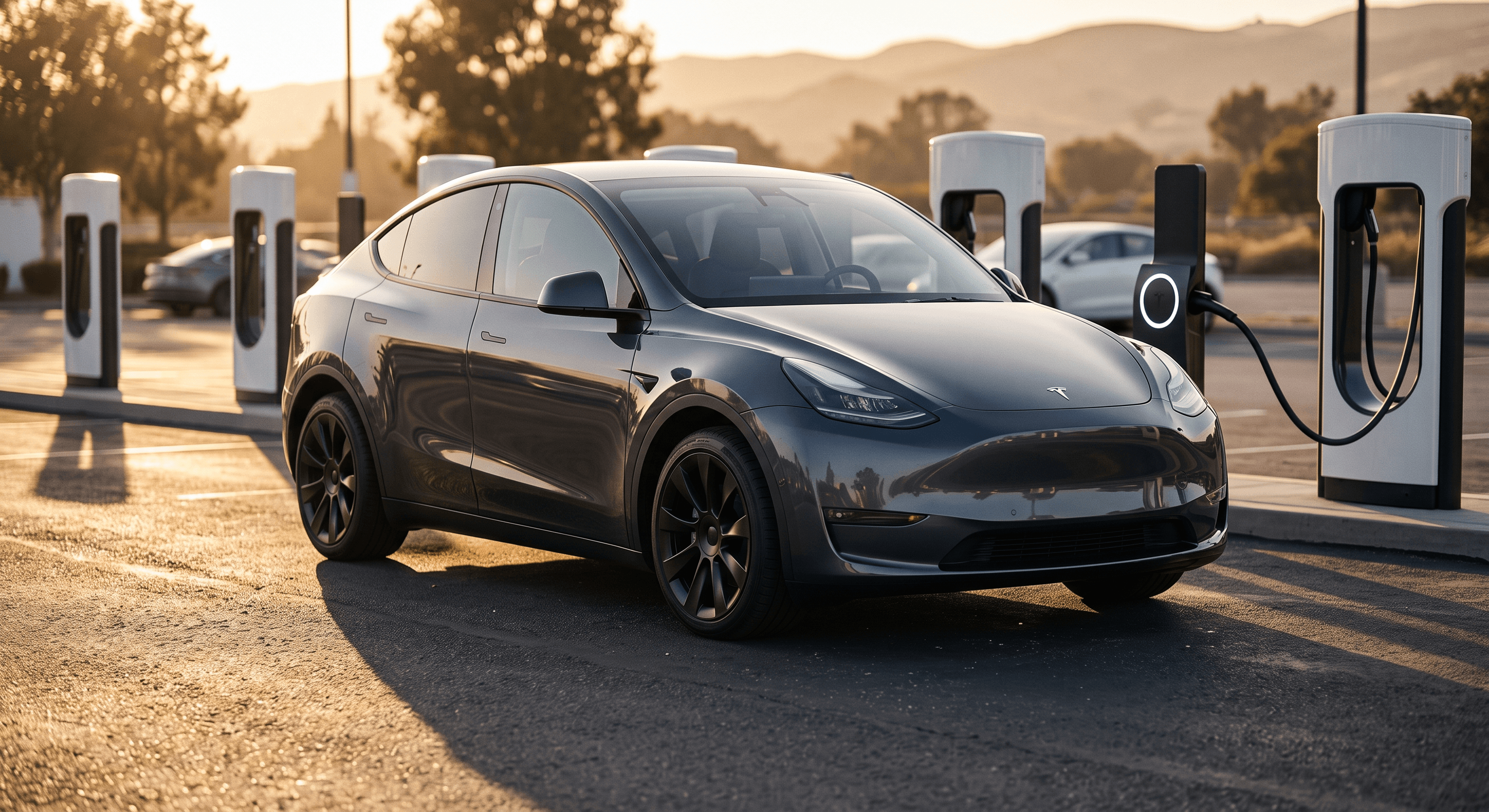
Thanks to Tesla's advanced thermal management system, frequent Supercharging does not accelerate battery degradation as heavily as the old myths suggest.
It's the biggest myth left over from early-generation EVs: "Constant DC fast charging ruins the battery."
Real-world data completely debunks this. Tesla's active thermal management system (liquid cooling/heating) preconditions the battery to the optimal temperature the moment you navigate to a Supercharger. It also actively manages the heat while plugged in. The comprehensive electric car battery health research by Recurrent Auto, which analyzed tens of thousands of vehicles, shows there is no statistically significant difference in degradation between Teslas exclusively using DC fast chargers and those strictly using low-voltage (AC) home chargers.
So, don't hesitate to plug into those 250 kW V3/V4 stalls on road trips; the system was engineered to handle it. Most cars that have passed the 100,000-mile mark still retain 85% to 90% of their original battery capacity.
"Lost Range" and BMS Calibration (You Must Try This)
If you are experiencing an unexplained drop in range, the issue is usually not the battery itself, but the car's brain (BMS - Battery Management System). If you constantly do short charging sessions between 40% and 70%, the system forgets how to read the battery's true "empty" and "full" points. The voltage balance drifts, and the screen shows you less range than you actually have.
The fix is remarkably simple (especially for NMC users):
- Drain the car's battery down to single digits (around 5-10%).
- Leave the car parked and asleep for a few hours without plugging it in (let the BMS measure the bottom voltage limit).
- Then, plug the car into an AC charger and let it charge uninterrupted to 100%. Even if you get the "charging complete" notification, don't pull the plug immediately; let the system balance the cell voltages.
- After this process, you will see the estimated range on the screen climb back up. Nothing was actually lost; the system just recalibrated itself.
When is it Time for a Service Visit?
Like any mechanical or electronic part, batteries can have factory defects. Tesla's warranty is clear: Depending on your model, your battery capacity will not drop below 70% for 8 years or 100,000 / 120,000 miles.
You should book a service appointment directly through the app if:
- Despite healthy charging habits and BMS calibration, your remaining capacity hits that 70% threshold.
- Your range drops by absurd amounts like 10-15% overnight and stays there permanently (this points to a failure in one of the cell modules).
- You get hardware error codes on the screen like "BMS Error (e.g., BMS_a066)" or "Maximum charge level reduced."
Minor fluctuations outside of these scenarios are caused by cold winter weather, your wheel/tire setup, or aggressive driving habits. Don't obsess over the percentage on the screen; know the machine's limits and focus on the drive.
What Happens When the Warranty Expires? Tesla Battery Replacement Costs
Let's say you've exhausted your 8-year or 120,000-mile (for Long Range and Performance) warranty, and the worst-case scenario happens: your battery completely fails. Or a more likely scenario: you bottom out hard, puncture the battery armor, damage the cells, and the incident falls out of warranty since it's considered user error. How much is coming out of your pocket or your insurance?
First, let's clear the air: Statistically speaking, looking at millions of Tesla data points, the probability of a complete, spontaneous battery failure is well under 1%. Most of these cars will run on their original packs until the chassis falls apart. However, you have the right to know the costs.
At Tesla Service Centers, battery packs are priced heavily based on parts and labor. Based on user experiences and global service invoices, the cost for a complete battery replacement—including labor and logistics—looks roughly like this:
- Remanufactured Battery Packs: These are older packs revised with healthy modules and backed by a Tesla warranty. Depending on the casing and capacity, the average cost ranges from $10,000 to $13,000 USD.
- Brand New Battery Pack: If you request a brand-new, factory-fresh LFP or NMC pack out of the crate, the total cost can climb up to the $15,000 to $20,000 USD range.
These numbers might sound terrifying at first. But remember; just as we don't lose sleep driving a premium internal combustion car thinking, "What if the engine blows at 100,000 miles, how much will a crate engine and transmission cost me?", the situation is no different for EVs. These figures shouldn't be a source of stress, just a technical reality to keep in mind. Make sure your comprehensive insurance covers battery damage, and enjoy the ride.
Comments (0)
🌍 Drivisual.tv is visited from over 60 countries. No matter what language you write in, your thoughts can help a fellow car enthusiast on the other side of the world thanks to our instant AI translation. Feel free to share your thoughts in your native language!
No comments yet. Be the first to share your thoughts!
Leave a Reply