BYD Atto 2: Is Being an Affordable Electric SUV Enough?
The BYD Atto 2 stands out as an affordable electric SUV, but does it offer enough beyond its price? This review explores its design, performance, range and how it stacks up against key rivals.


Contents
- Design: Searching for Identity or Playing It Too Safe?
- Technical Foundation: The Strength of Blade Battery Technology
- Interior: Minimalism Meets Digitalization
- Driving Experience: Comfort Over Engagement
- Performance and Range: Adequate, Not Outstanding
- Market Position and Segment Analysis
- Major Comparison (Core Differences)
- Pricing: Its Strongest Advantage
- The Real Issue: Being Too Balanced
- Who Should Consider It?
- Conclusion
Competition in the electric vehicle world is no longer defined solely by range and acceleration. Design, software quality, interior feel, and driving character have become just as decisive as technical specifications. Chinese manufacturer BYD is pursuing an aggressive strategy in this new landscape. Its compact SUV, BYD Atto 2, represents the most accessible link in that strategy.
As BYD continues its rapid global expansion, the ATTO 2 (known as Yuan UP in some markets) has drawn significant attention, particularly in Europe and Turkey. Following the success of BYD Atto 3, this smaller and more affordable model has not only broadened the brand’s reach but also sparked serious debate.
Here is everything you need to know about the BYD ATTO 2, from its design to its technical foundation.
Design: Searching for Identity or Playing It Too Safe?
One of the most common criticisms of the Atto 2 is its design. At first glance, it looks modern—but it lacks memorability. Sharp lines, slim LED headlights, and clean proportions give it a contemporary SUV appearance, yet the overall character feels subdued.
Critics tend to focus on a few key areas:
Proportions and Stance:
Despite its raised ride height, the relatively narrow body proportions weaken its SUV presence. Even with larger wheel options, the visible wheel arch gaps can create a slightly “floating” look.
Front Fascia:
Compared to the more futuristic styling of the Atto 3, the Atto 2 adopts a softer, more approachable face. While this may broaden its appeal, some see it as a dilution of BYD’s technological identity.
Rear Lighting:
The full-width LED light bar adds a modern touch, but similar designs are now widespread among Chinese manufacturers, raising questions about originality.
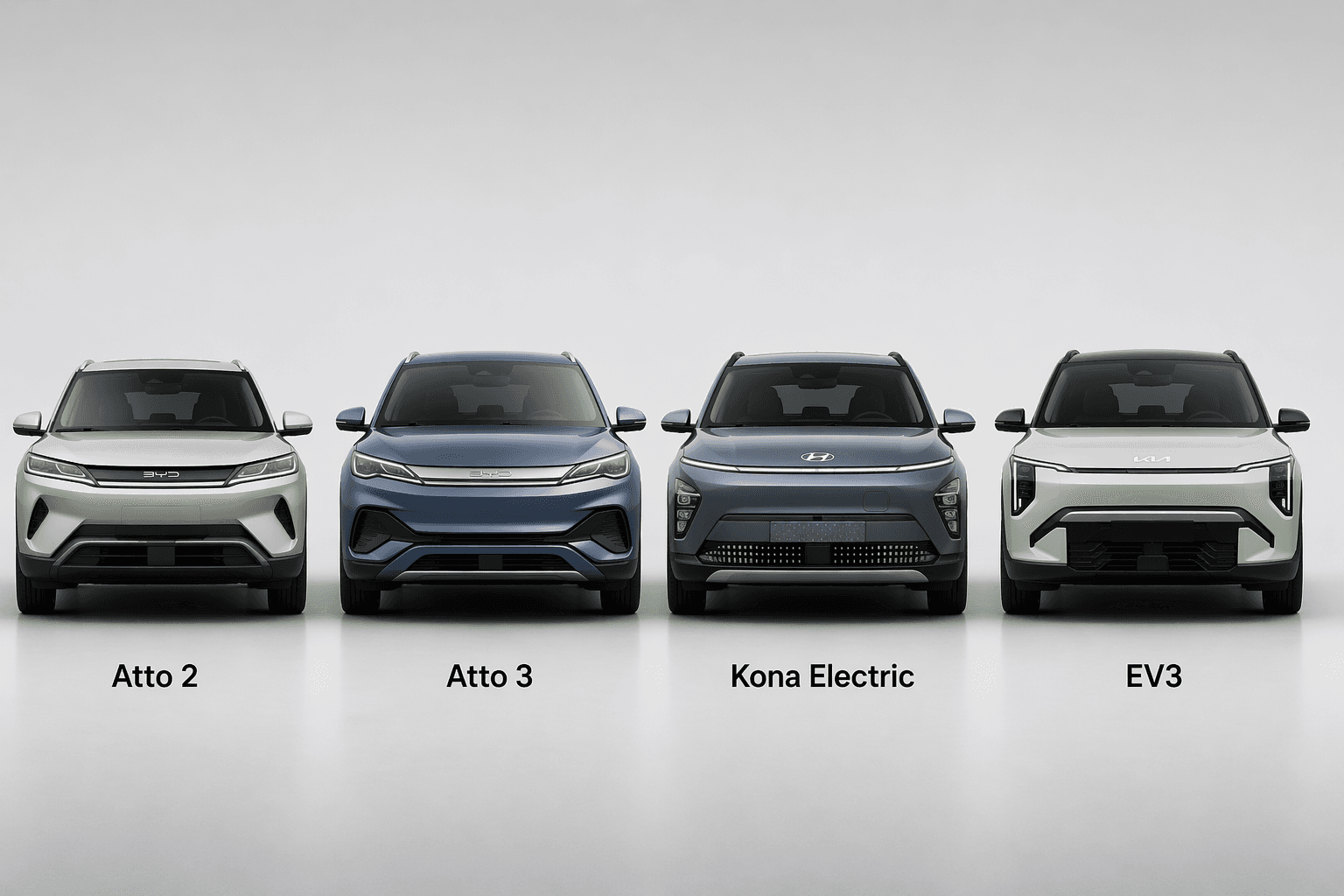
In today’s compact SUV segment, standout design is often a key differentiator. Models like the Kia EV3 lean toward a bold, futuristic aesthetic, while the Hyundai Kona Electric distinguishes itself with striking lighting signatures. The Atto 2 sits somewhere in between—safe, but for many, somewhat uninspiring.
This becomes particularly relevant for younger buyers, for whom design is no longer just a preference but a primary purchasing factor.
Technical Foundation: The Strength of Blade Battery Technology
While design is subjective, BYD’s technological capabilities are far more concrete. The ATTO 2 is built on the brand’s advanced e-Platform 3.0 architecture.
Power Options:
The model is typically offered with two motor configurations: 70 kW (95 PS) and 130 kW (177 PS). These figures are more than sufficient for urban use, with the higher output version delivering respectable performance.
Battery and Range:
BYD’s lithium iron phosphate (LFP) Blade Battery technology is a major highlight. With battery capacities of 32 kWh and 45 kWh, the ATTO 2 offers a WLTP range of approximately 300 to 400 kilometers in urban conditions.
Charging:
Fast charging capability allows the battery to go from 30% to 80% in roughly 30 minutes, making it a practical option for daily use.
Interior: Minimalism Meets Digitalization
BYD is generally ambitious when it comes to interior design, as clearly seen in the Atto 3. However, things are more restrained in the Atto 2. Interestingly, the criticisms aimed at the exterior often give way to appreciation once inside the cabin.
Key highlights include:
- Rotating infotainment display
- Digital instrument cluster
- Solid material quality for its class
Despite these strengths, the overall ambiance feels simpler and more cost-focused. The playful and distinctive interior design language of the Atto 3 has been toned down, making the Atto 2 more functional but less emotionally engaging.
Material Quality:
Soft-touch surfaces and decent upholstery are strong points for the segment. However, the near-total absence of physical buttons has drawn criticism from an ergonomics standpoint.
Space:
At around 4.3 meters in length, efficient use of the wheelbase results in surprisingly good rear legroom.
Driving Experience: Comfort Over Engagement
The Atto 2 is clearly tuned for urban driving.
- Soft suspension
- Light steering
- Quiet ride
These characteristics make it comfortable in daily use. However, that comfort comes at the expense of driving excitement.
Body roll is noticeable in corners, steering feedback is limited, and the overall driving feel remains neutral. This is not a car for enthusiasts—it is designed for those who simply want a smooth and stress-free commute.
Compared to its rivals:
- The Kia EV3 offers a more balanced and modern driving experience
- The Hyundai Kona Electric feels more stable and predictable
- The Atto 2 delivers the softest ride, but also the least engaging one
Performance and Range: Adequate, Not Outstanding
On paper, the Atto 2’s figures are respectable, but they fall slightly behind the competition.
- Approximately 174 hp
- 0–100 km/h: around 7.9 seconds
- Range: approximately 345–420 km
These numbers are sufficient for city use, but many competitors now offer longer range and faster charging.
In particular:
- The Kia EV3 stands out with more advanced battery technology
- The Kona Electric excels in efficiency
- The Atto 3 strikes a better balance between performance and range
Within this landscape, the Atto 2 positions itself firmly in the “average” category.
Market Position and Segment Analysis
The ATTO 2 competes strongly in Europe’s B-SUV segment against models such as the Peugeot e-2008, Volkswagen ID.3, and Hyundai Kona Electric, primarily through its aggressive pricing.
In markets like Turkey, where tax brackets and incentives play a major role, the Atto 2 is expected to become a key player in the accessible EV category. Despite design criticisms, BYD’s software integration and battery safety make it more than just a means of transportation—it becomes a rational investment.
Major Comparison (Core Differences)
| Feature | Atto 2 | Atto 3 | Kona Electric | EV3 |
|---|---|---|---|---|
| Segment | B-SUV | C-SUV | B-SUV | B/C-SUV (between segments) |
| Power | ~130 kW | 150 kW | 99–150 kW | ~150 kW |
| 0–100 km/h | ~7.9 s | ~7.3 s | ~9.9 s | ~7.5 s |
| Range | ~345 km | ~345–420 km | ~395 km | ~400+ km |
| Trunk Capacity | ~400 L | 440 L | 332–361 L | ~460 L |
| Character | Budget / city-focused | Balanced | Efficient / reliable | Next-gen / tech-focused |
📌 Atto 3 strikes a balance between performance and space,
📌 EV3 excels in technology and range,
📌 Kona plays the "reliability and efficiency" card.
Pricing: Its Strongest Advantage
The Atto 2’s biggest strength is, without question, its pricing strategy.
With this model, BYD aims to:
- Lower the barrier to EV ownership
- Reach a broader audience
- Become the go-to choice for first-time EV buyers
This approach works. For many users, compromises such as:
- Slightly shorter range
- Simpler design
- Modest performance
are acceptable in exchange for a more affordable price.
The Real Issue: Being Too Balanced
The Atto 2’s biggest weakness is not technical—it’s emotional. A lack of character.
This is not the fastest car.
Not the most efficient.
Not the most advanced.
Not the most stylish.
But it offers a bit of everything.
That makes it a rational choice—but not an exciting one.
Who Should Consider It?
The Atto 2 is a logical choice for:
- Buyers entering the EV market on a budget
- Urban-focused drivers
- Those with modest performance expectations
- Users prioritizing value for money
It may not suit:
- Design-focused buyers
- Long-distance drivers
- Enthusiasts seeking driving engagement
- Those who want their car to feel distinctive
Conclusion
The BYD Atto 2 is a crucial model for the growth of the electric vehicle market. Its accessible pricing has the potential to bring more people into the EV ecosystem.
However, in today’s automotive landscape, accessibility alone is not enough. Emotion, character, and distinction matter just as much as technical capability.
The Atto 2 plays it safe—perhaps too safe.
And that is precisely why it risks being overlooked.
In the end, it may not be a car that captures hearts at first glance, but with its underlying technology and everyday usability, it stands a strong chance of winning over rational buyers.
Comments (0)
🌍 Drivisual.tv is visited from over 60 countries. No matter what language you write in, your thoughts can help a fellow car enthusiast on the other side of the world thanks to our instant AI translation. Feel free to share your thoughts in your native language!
No comments yet. Be the first to share your thoughts!
Leave a Reply