1.2 PureTech Engine Warranty Periods and Stellantis’ New Support Policy: What Vehicle Owners Need to Know
Learn about Stellantis 1.2 PureTech wet belt & oil consumption issues, extended warranties, and reimbursement programs for owners.


Contents
- The Development of the 1.2 PureTech Engine
- What Is the Wet Belt System?
- Which Model Years Have Been Most Frequently Affected?
- The Most Common Issues Reported by Owners
- What Does Stellantis’ Extended Warranty Program Cover?
- Reimbursement Program for Previous Repairs
- How the New European Support Program Works
- Can Used-Car Owners Receive Support?
- Warning Signs Owners Should Monitor
- What Has Changed in Updated Engine Versions?
- Social Media and Owner Community Perspectives
- How Reliable Is the PureTech Engine Today?
- Expert Opinion
- Conclusion / Overall Assessment
In recent years, one of the most widely discussed technical topics in the European automotive industry has been the durability concerns associated with Stellantis Group’s widely used 1.2 PureTech petrol engines. Issues related to the oil-immersed timing belt system—commonly known as the wet belt—as well as reports of excessive oil consumption and, in some cases, engine damage, have attracted significant attention from both vehicle owners and the used-car market.
In response, Stellantis introduced a range of warranty extensions, customer support programs, and reimbursement mechanisms covering brands such as Peugeot, Citroën, Opel, and DS Automobiles. The company’s latest initiatives indicate a more proactive approach to addressing customer concerns and restoring confidence in affected vehicles.
So, what problems have been associated with the 1.2 PureTech engine, how has warranty coverage been expanded, and under what conditions can owners benefit from Stellantis support programs?
The Development of the 1.2 PureTech Engine
The PureTech family was originally developed by PSA Group as a series of three-cylinder turbocharged petrol engines designed to reduce emissions while improving fuel efficiency.
The engine quickly gained industry recognition, including multiple International Engine of the Year awards, thanks to its ability to deliver strong performance from a compact displacement. Following the formation of Stellantis, the engine became even more widespread across the group’s vehicle lineup.
Which Brands Used the PureTech Engine?
The 1.2 PureTech engine has been widely used across:
- Peugeot
- Citroën
- Opel
- DS Automobiles
It has powered numerous models, including the Peugeot 208, 2008, 308, 3008 and 5008, as well as the Citroën C3, C4 and C5 Aircross, Opel Crossland and Grandland, and several DS models.
What Is the Wet Belt System?
At the center of the PureTech discussion is the wet belt timing system.
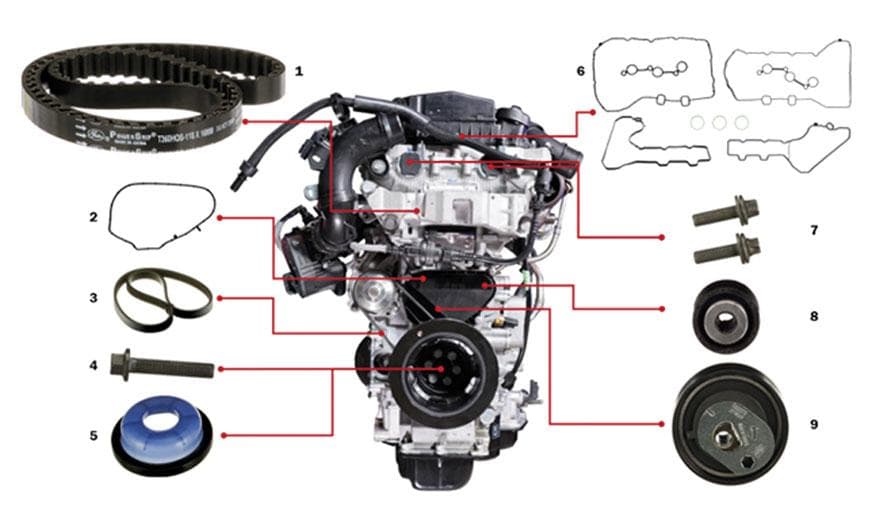
Why Was an Oil-Immersed Timing Belt Used?
Unlike conventional timing belts that operate in a dry environment, the wet belt design places the belt inside the engine’s oil circuit.
The concept was intended to:
- Reduce friction
- Improve fuel efficiency
- Lower operating noise
- Enhance mechanical efficiency
Why Did It Become Problematic?
Although technically promising, the system did not achieve the expected durability levels in certain production periods.
In some cases, belt material degradation occurred over time due to prolonged exposure to engine oil. This could lead to:
- Blocked oil passages
- Reduced oil pressure
- Timing irregularities
- Internal engine damage
Which Model Years Have Been Most Frequently Affected?
Reports and warranty programs have primarily focused on earlier-generation EB-series 1.0 and 1.2 PureTech engines. Vehicles produced between approximately 2014 and 2022 have appeared most frequently in owner complaints and technical discussions.
However, it is important to note that not every vehicle experienced these issues. Factors such as maintenance quality, driving conditions, oil specifications, and service history have all played a significant role in long-term reliability.
The Most Common Issues Reported by Owners
Excessive Oil Consumption
Some owners reported oil consumption levels exceeding what would typically be considered normal.
Potential consequences include:
- Frequent oil top-ups
- Emissions-related issues
- Reduced engine performance
Timing Belt Degradation
One of the most widely reported concerns has been premature wear of the timing belt.
As belt particles circulate through the lubrication system, oil flow can become restricted, increasing the risk of further mechanical complications.
Risk of Engine Damage
If the issue progresses, symptoms may include:
- Low oil pressure
- Timing-related fault codes
- Engine warning lights
- Starting difficulties
In severe cases, extensive engine repairs may be required.
What Does Stellantis’ Extended Warranty Program Cover?
In 2024, Stellantis introduced an expanded support program for previous-generation 1.0 and 1.2 PureTech engines.
According to official company statements, eligible vehicles may benefit from coverage of both parts and labor costs, with support reaching up to 100% under certain conditions. In some markets, protection can extend to 10 years or 180,000 kilometers.
Conditions for Eligibility
Coverage is not automatically granted to every vehicle.
Typical eligibility criteria include:
- Maintenance performed according to the manufacturer's schedule
- Compliance with prescribed service intervals
- Availability of maintenance documentation
- Confirmation that the failure is related to covered issues
Stellantis has repeatedly emphasized the importance of documented service history when assessing claims.
Reimbursement Program for Previous Repairs
In 2025, Stellantis expanded its customer support efforts by launching an online compensation platform across Europe.
Under this initiative, eligible customers who previously paid for certain repairs out of pocket may apply for reimbursement.
The program primarily focuses on repairs related to:
- Excessive oil consumption
- Premature timing belt deterioration
Applicants are generally required to provide invoices, maintenance records, and supporting documentation demonstrating that the repair falls within the scope of the compensation policy.
How the New European Support Program Works
The latest European support framework represents one of Stellantis’ most comprehensive responses to the PureTech issue.
The program combines several measures:
- Extended warranty coverage for eligible vehicles
- Increased goodwill support for certain repair cases
- Reimbursement opportunities for past repairs
- Dedicated online claim submission platforms
- Harmonized customer support procedures across multiple European markets
The objective is not only to reduce repair costs for affected owners but also to strengthen confidence in Stellantis brands across the region.
The Importance of Service History
One of the most critical factors in warranty and reimbursement assessments is the vehicle’s maintenance record.
Owners who can demonstrate:
- Timely servicing
- Compliance with approved maintenance procedures
- Use of recommended lubricants and parts
are generally in a stronger position when applying for support.
Missing service documentation can significantly complicate the evaluation process.
Can Used-Car Owners Receive Support?
One of the most common questions concerns second-hand vehicles.
Many of the support programs focus primarily on the vehicle itself and its maintenance history rather than ownership status alone. As a result, used-car owners may also be eligible for assistance if all required conditions are met.
However, incomplete maintenance records or undocumented repairs can affect eligibility.
Warning Signs Owners Should Monitor
Owners of 1.2 PureTech-powered vehicles should pay attention to:
- Frequent oil level drops
- Engine warning lights
- Rough cold starts
- Unusual mechanical noises
- Oil pressure alerts
Early diagnosis can help prevent more extensive and costly repairs.
What Has Changed in Updated Engine Versions?
Over time, Stellantis implemented several engineering updates affecting timing belt materials, maintenance procedures, and inspection intervals.
More significantly, the company has transitioned many of its latest-generation electrified 1.2-liter powertrains to timing chain systems, reducing dependence on the wet belt architecture.
This shift is widely viewed as a key element of Stellantis’ long-term strategy to improve durability and ownership costs.
Social Media and Owner Community Perspectives
Opinions within owner communities remain mixed.
While some users report significant reliability concerns, others have accumulated substantial mileage without experiencing major issues.
For this reason, forums and social media discussions can provide useful insight into ownership experiences, but official manufacturer communications and verified technical information should remain the primary sources when evaluating warranty rights and support programs.
How Reliable Is the PureTech Engine Today?
The PureTech engine’s reputation has undoubtedly been influenced by the issues experienced in earlier production years.
However, several developments have improved the outlook:
- Updated components
- Revised maintenance procedures
- Expanded warranty coverage
- New-generation chain-driven engines
Together, these measures suggest that Stellantis has taken meaningful steps to address known concerns and improve long-term reliability.
Vehicles with documented maintenance histories and updated components are generally considered lower risk than earlier examples that have not received the relevant improvements.
Expert Opinion
The 1.2 PureTech story serves as an important example of the delicate balance between efficiency-focused engineering and long-term durability in the modern automotive industry.
Stellantis’ response has extended beyond technical revisions. Warranty extensions, goodwill policies, and reimbursement programs represent significant efforts to rebuild customer confidence and demonstrate accountability.
For prospective used-car buyers, the most important consideration is not simply the engine type but the quality and completeness of the vehicle’s maintenance history. Timing belt inspection records, documented servicing, and evidence of any relevant updates should play a central role in the purchasing decision.
Conclusion / Overall Assessment
The 1.2 PureTech engine has become one of the most discussed small-displacement petrol engines in Europe due to concerns surrounding wet belt durability and oil consumption. At the same time, Stellantis has implemented one of the industry's most extensive customer support responses, including warranty extensions, reimbursement mechanisms, and enhanced goodwill programs.
Today, support programs offering protection of up to 10 years or 180,000 kilometers provide a meaningful level of reassurance for eligible vehicle owners. Nevertheless, maintaining complete service records, monitoring early warning signs, and staying informed about current manufacturer policies remain essential steps for both existing owners and prospective used-car buyers.
As Stellantis continues its transition toward updated engine architectures and chain-driven timing systems, the long-term perception of the PureTech nameplate will likely depend on how effectively these engineering and customer-support measures perform over time.
Comments (0)
🌍 Drivisual.tv is visited from over 60 countries. No matter what language you write in, your thoughts can help a fellow car enthusiast on the other side of the world thanks to our instant AI translation. Feel free to share your thoughts in your native language!
No comments yet. Be the first to share your thoughts!
Leave a Reply